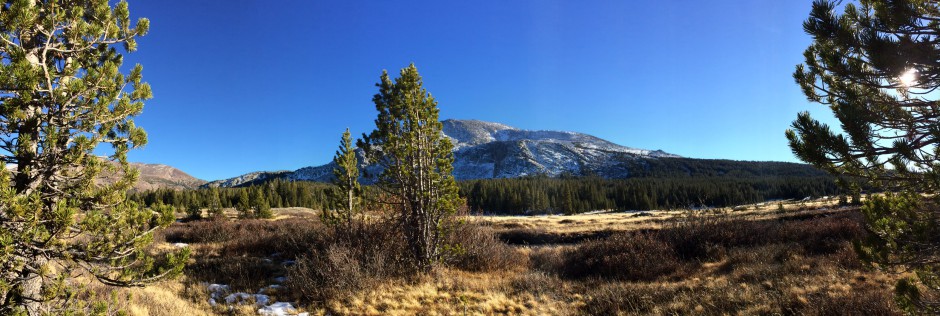
How to love and defend the earth? I recently spent two weeks exploring my connection with wilderness in Kings Canyon National Park in the Sierra mountains. My companions? Thomas Berry and The Great Work, natural history guide books, land/earth, air/wind, water/river/creek, and a multitude of beings who surrounded me with their integrity, purpose, and presence.
Before I went, I asked several people what their practice might be if they were seeking to connect with nature. I got a few responses, including silence, reading, photography, and journaling, all of which I did. The most helpful advice came from my 80-year old godmother, who has a lot of history with walking in nature. She said, “Go easily and slowly. Take time to come to your senses. You don’t know what will happen; you need to have a sense of purpose and trust. Look carefully at the trees, stones, leaves. Smell, touch, listen, etc. Let what needs to happen happen. Face your fears. You don’t have to dig deep. Let your senses be fully alive, let nature come at you. Whatever needs to surface will.”
Oh yeah, I realized. This is about relationship, not about ownership or self-gratification. If I’m going into this expecting to create an experience, then I’m not honoring the other half of the equation. It is enough to show up expectantly, with an open heart, trusting that I will be met and let the relationship unfold. Her advice was wise and true.
For those two weeks, I spent many hours by the creek and in the forest watching and “sensing.” I took walks, backpacked for three days, swam in the river, sweated out the 90-plus degree weather, went stargazing, collected pine cones and twigs, journaled, read, made nature art, and identified flowers, trees, insects, plants, and animals.
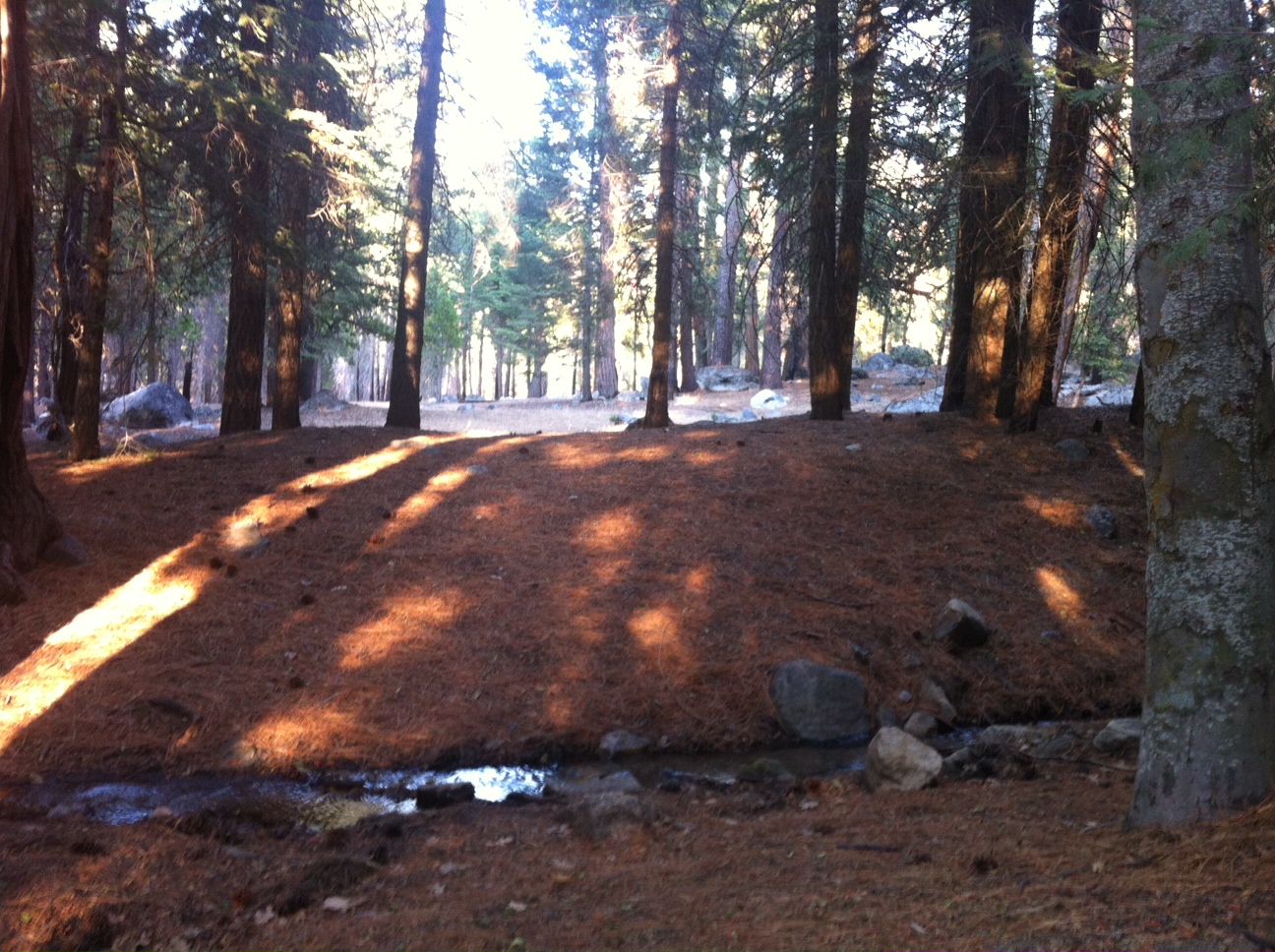
My daily view of Sheep Creek and the forest
It seems like a lot to pack into such a short time, but I really didn’t have any other aim other than to place myself into a receptive mode. Amazingly, I experienced the wild in so many different ways: as companion, healer, wounder, teacher, magician, playmate, lover, and guide. But mostly, I came to feel the presence of living beings all around me, to feel surrounded in a personal way by Life accepting of me. Not talking to me or being human-like, but aware of me. Animals and trees fully in their integrity, as subjects of their own lives into which I was briefly stepping.
The shift I was ready to make in this experience was moving from objectifying nature to allowing that living beings have their own subjective experience and I can find my place in wilderness only within this awareness. Berry wrote: “…every being has its own spontaneities that arise from the depths of its own being. These spontaneities express the inner value of each being in such a manner that we must say of the universe that is is a communion of subjects, not a collection of objects.” And that, “the renewal of life on the planet must be based on the continuity between the human and the other than human as a single integral community.” (Chapter 7).
When I returned home, I felt full and enriched. I also felt bereft. The trees surrounding my campsite, so very tall and elegant, had come to be dear to me. Not their species (oak, pine, alder), but their active presence filling me with the sense of purpose and integrity of the universe. I have cried on several occasions making this shift back to the tree-barren city in which I live. I feel sad to say good bye, this time. But I will be back.
In his book, Berry quotes an African Bushman (from A Far-Off Place by Laurens van der Post) who said, “One is never alone in the forest. One is never unobserved.”
 luminous immensity